(Counselor Conversation – Visiting Professional Series)
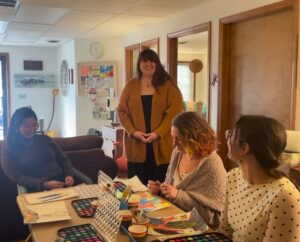
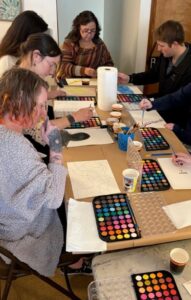
“Create Your Inner Landscape as a Counselor” was the prompt given to our team when Katie Curran, MA, LMHC led us through an art experiential process. As we engaged in art making, I reflected about how to depict my own journey as an older counselor and the multiple hats I wear as a supervisor, trainer and business owner. And along with this, along I also carry my personal way of being. I ended up creating a path around the beginning of my career, learning along the way and the present moving into the future (depicted as a bridge) into aging and retirement. I reflected about the joys and challenges (in the smaller and bigger world), the need for safety, letting go that has served me and the hopes around lives touched along the way. I was aware of how I was touching on emotion, saddened by some regret (yet lessons learned) and current challenges, while being overall proud of who I am and my intentions in the work I do. This is the power of art to reflect, emote, heal and navigate aspects of our lives.
With my team, I was in awe of each person’s final art piece and their uniqueness, how we tend to walk through the world so differently and the joys and challenges that we experience as counselors and humans. This experience allowed us to be introspective, to externalize meaning and to have more understanding of each other.
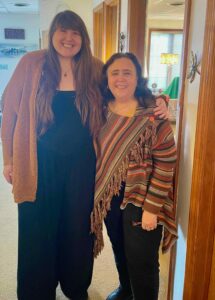
Katie is naturally drawn to using creative arts in her counseling practice. She also teaches classes and sees the value of this in groups. Given this, many clients reach out to her, who are also drawn to artistic modalities. I asked Katie to join us having had the opportunity to provide supervision with her as she moved towards licensure. I value Katie’s wisdom and authenticity as a counselor and was thrilled when she said that she was willing to join our team and share more about her love for art in therapy. Katie emphasized the cathartic work she sees enhanced in using art, considerations around the use of various mediums and she brainstormed with us around expanding the single prompt of “creating an inner landscape as a counselor” to multiple ideas or prompts to use with clients with issues from grief and mourning, adjustment, trauma and so much more.
I have summarized our teams take-away learning from Katie in hopes that it might spur some learning for you as a reader as well.
“This was insightful to me. It opened my mind to the new possibilities and to stop and reflect.” (Eli, EWU Bachelor Level Intern and Office Support)
The process starts with creating and as the process unfolds, it can lead to profound discoveries and understanding that may surprise or enlighten a person.
“There is a parallel amongst expressive therapies. There is not a right way to do things, but some kind of thread comes through with some consistency.” (Lauren, Counselor)
Not everyone will be able, ready, interested or willing to lean into using art or be ready to sit with the emotions art in therapy or processing can bring. We must be conscious of when a modality is used, with whom and when.
“How vulnerable it is. When other people are embracing it, you feel so much more comfortable going there in a way. I am imagining how this might be for clients – to let their protectiveness down.” (Aria, Counselor)
The reminder about the use of art in therapy does not have to be confined to using it with children. This process can be informative and healing for teens and adults as well. (Gillian, Counselor)
Art may allow some clients that are very cognitive to get out of their head and into their hearts.
Art prompts could be broken down into small parts of a story, issue or journey to process slower or more targeted areas. Or can be more global, such as, “create your world,” to allow the client to determine the parameters. It can also be non-directive, starting with creating and seeing what arises. It can be utilized in so many ways.
“I noticed the sense of comparison – that can come in – or thinking about the ‘right way’ to go. Doing the art my way, it can’t be wrong. Being okay with that.” (Megan, Whitworth, Bachelor level intern)
Katie expanded upon what we each had to say, noting that the final product is less important than the actual process for clients to come to their own answers and the ability to connect with emotions or reflect on aspects of their lives. We explored vulnerability and holding space when asking clients to consider this method. Katie emphasized how an art experience allows clients that may struggle to self-disclose through words, to examine this more reflectively through externalizing it with a tangible product. She also related how people can get stuck in their lives and creative processes allow movement, deeper reflection and meaning making that may not come with talk therapy alone.
I had an opportunity to use Katie’s prompt with a graduate level class that I was teaching as a visiting professional at Gonzaga University, shortly after her visit. I asked the students to create their inner landscape as a graduate student counselor. I also introduced them to symbolism through the use of sand tray. Following the class, I received student feedback, noting that they appreciated both the experiential processes that allowed them to have a deeper experience to know and understand themselves and each other.
Katie inspired us in a way that it is the gift that keeps giving. She allowed our team to explore and expand upon ideas for client centered creative prompts with art and sand. She reminded us about the power of art to express, feel and process, amidst making connections in a group as well. The ripple from one counselor to another is a big one and far reaching when we learn from each other. Thank you Katie, for your time, expertise and the ripple you make daily and for sharing this experience with us, allowing us to ripple this further in the work that we do as well.

 Create Your Inner Landscape